Sunday, June 19, 2011

Almost There...

There are three more days until I leave for my trip. I can’t believe it! It feels like yesterday that I was being interviewed and was chosen to go to Columbia!

It hadn’t really hit me that I was leaving my comfort zone until last Thursday, when I said goodbye to my co-workers that were also going on vacation. It sank into my head that it was almost time to leave when they asked “when are you returning?” and I replied “in about a month…” Almost a month without my family, friends, my bed, my grandmother’s cooking, my dog, and most importantly, the comfort that I have in my own home. As I started to pack I realized that this is what it’s going to be like next year when I really go off to college, packing and saying my goodbyes to people I wouldn’t be seeing in a while. It also sparked excitement in me that everything I will be experiencing is new. New places, new people, new perspectives. It will be something new to look forward to.

As I packed, I realized that it’s not so easy to pack for a trip like this. You need a broad range of clothes, like fancy formal clothes for dinners, clothes appropriate for tours, appropriate for class, and some to go sight-seeing in. I thought I knew what I needed to pack. Yes, I was wrong. I had to email my chaperone probably at least four times to ask for her advice on what to pack. The airport isn’t helping at all with all of the restrictions on luggage weight it has made.

I’ve made a list of places I want to visit while in New York City. It has a lot to offer a young person with the willingness to adventure into the world. The museums are endless there, but I would like to visit in particular the Smithsonian and El Museo Del Barrio. I’d also like to visit Ground Zero, Central Park, and the annual Nathan’s Hot Dog Eating Contest on Coney Island. Last year’s record was 54 hot dogs! I wonder if they can break it this year. Of course, this isn’t my whole list of things to see. Things might pop up on the plane ride there!

As the day creeps closer and closer, I become more and more nervous. I’m excited to see one of the greatest cities in the world and some of the greatest universities in the country.

Friday, June 17, 2011

Show Me The Money!

You have the brightest child in the neighborhood and everyone knows it.  Any university in the country would be lucky to have your child.  Without exception, though, all of the top flight schools cost a fortune to attend.  We’re not talking about new car kind of money.  We’re talking about the kind of money to buy a decent house—the kind where you have to keep paying for it forever and ever.  The kind f money it takes a regular working family decades to prepare for.
What are you going to do?  You make decent money—at least enough to keep the rest of your family living comfortably—but it’s not really enough to keep them living comfortably and leave enough to pay for that college education.  The cost of living here in the Bay Area eats up most of your paycheck—when you get a paycheck—and leaves little to sock away to pay for a decent education for your children.
You and your child could take out loans to pay for that top flight education but what kind of life would that be for your child to graduate owing almost as much as the National Debt?
Your child could get a job but what kind of money could an 18 year old make before acquiring the skills that the college education will help provide?
What’s a parent to do?  How are you supposed to take care of your family and provide them with a quality education—the kind of education that will open the right doors once your child has that sheepskin firmly in her grasp?
What are you supposed to do?  You’re supposed to turn to The Ivy League Connection’s very own Sue Kim—a professional educational consultant specializing in admissions and financial aid counseling since 1991.
Sue has helped many dozens of ILC students and others from the WCCUSD find the perfect fit of a college and then find a means to pay for that education.  She knows what she’s doing and she’s good at it.
On Thursday June 16th Sue hosted 39 ILC and WCCUSD students and parents in a financial aid workshop where she helped point the way for the parents to find ways for other people to pay for the education of their children.
Between grants, scholarships, gifts and other options that may be available to the students and parents in our area, more and more of our students have opportunities to attend better schools than they might otherwise have been considering.
Sue explained that although California has an outstanding 10 campus University of California and a 23 campus state university system, both systems have little money to offer students in the way of financial assistance.  The cost to attend these schools is prohibitively expensive and the costs are steadily rising.
On the other hand, there are numerous private colleges spread throughout the country that have large endowments designed to help the very kinds of students we seem to have an abundance of: smart but needy.
Tonight’s session was only a primer but it laid the foundation so parents and students can start their preparations.  Once their students enter their senior year of high school, the college application process becomes a full time job requiring a tremendous amount of dedication and attention to detail.  There are openings at these schools and there is money to be had but if our students and their parents don’t do the necessary homework and prepare themselves, those opportunities may go elsewhere.  We want everyone around the world to have the option of getting a top education but if there are limited funds and limited openings, then we’d rather that our people be taken care of first.  Call it selfish if you will—and you’d be right—but such is life.

Tuesday, June 14, 2011

The First American University

Our chaperone Mrs. Lilhanand asked us each to pick a topic to research before we make our trip to New York. Since I was in charge of inviting guests from the University of Pennsylvania to join us for dinner, I thought it would be appropriate to research about The University of Pennsylvania.

The University of Pennsylvania is located in University City, Philadelphia. The school itself is situated in one of the United States' most historical cities.

It houses 25,007 students, about 10,000 undergraduates, 10,000 graduate/professional, and the rest part-time students. UPENN accepts 14% of the applicants that apply.

UPENN is often known for being the first liberal arts college of the country. The university was founded by Benjamin Franklin in 1740. It was originally founded to educate clergy, but Benjamin Franklin wanted it to be a college to educate the future professionals of the country. Originally called the College of Philadelphia, it was affected by everything the young America had to go through. It was seized by the state of Pennsylvania because it was thought to educate the Loyalists (British supporters) during the revolution. After the revolution had ended it was given its name: The University of Pennsylvania. The influence of the revolution gave UPENN the loyalty and spirit it has today: to educate the new generations to benefit the United States. The university has had the honor to be associated with nine signers of the Declaration of Independence and 11 signers of the Constitution either by donations or alumni. UPENN has had many achievements in its history, like being the first medical school in American and being home to the first digital computer.

There are several schools within the university itself. They consist of The College (School of Arts and Sciences), Wharton College (School of Business), School of Engineering and Applied Science, and School of Nursing. The other eight schools are for graduate students. It also has over 40 housing complexes that each have their own interests so that students can be house with people that like to do the same things and major in the same area.

As the years went by, UPENN prospered and changed. In the 1800s, the university transformed itself into a research institute because of pressure from other countries. The US had to be the best in the world and needed its universities to be able to come out with new ideas and inventions. It continued to experience changes in attendance because of the G.I. Bill that allowed World War II veterans the opportunity to attend college once they came home. The University today is ranked number 5 in undergraduate education. It continues to lead the Ivys in research and in U.S. News it has kept its number 1 ranking in business schools.

Personally, if I had not been offered the opportunity to go to the East Coast and have to know about the colleges there, I would have never considered adding UPENN to my list of colleges to apply to. After attending educational seminars given by the admissions officers and reading about the amazing engineering program UPENN offers, I am happy to say that I will hopefully add it to my list. I look forward to visiting this amazing university in less than 2 weeks!

Monday, June 13, 2011

A Stronger U.N. for a Better World

As independence and self-reliance are two of the lessons that we are expected to learn about our trip, our charming chaperone Mrs. L. encouraged our cohort to research an important landmark that we would be visiting so that we can serve as our own tour guides at these locations when we arrive on the east coast.

Here is my presentation on the United Nations:

The United Nations was originally founded on October 24th, 1945 and 51 nations were originally represented. The organization’s meetings occurred the Sperry Gyroscope Corporation's building in Lake Success, New York, from 1946–1952, until they were moved to what is now the United Nations Headquarters building in Manhattan upon its completion.

Numerous other sites were considered to house the United Nations, including San Francisco, Chicago, Boston, and other cities. The Manhattan site was chosen as the best option after oil tycoon and philanthropist John D. Rockefeller Jr. offered 8.5 billion dollars to purchase the land. The cost of construction of the complex was later reported at a (mere) 65 million dollars, which was provided by an interest-free loan from the United States to the United Nations.

The United Nations Headquarters is officially considered international territory; no United States officer may enter with out permission from the Secretary-General. That being said, the U.N. agrees to not allow its headquarters to be used as a safe zone for individuals trying to avoid legal process or extradition.

Today, the United Nations has 192 members and the Headquarters hosts 700,000 visitors annually. The complex is made up of four main buildings: the Secretariat, the General Assembly, Conference Area and the Library. Wallace K. Harrison of the United States, who also designed Hines Library at Harvard University, the New York Hall of Science, and the “Fish Church” in Stamford Conneticut, served as chief architect for the project.

The Secretariat building contains the administrative functions of the UN, and the offices of ambassadors and delegates. It has 39 stories above and 3 stories below ground. The General Assembly building was built for the United Nations delegation, where representatives from the 192 member nations meet in the hope of achieving “a stronger U.N. for a better world.” The United Nations’ chief goals are to maintain peace, promote social progress and cultural understanding, and allow peoples human rights and improved living standards. The Conference Building connects the Secretariat and General Assembly buildings and contains the delegates’ dining room, as well as private dining rooms and a kitchen.

The United Nations maintains its own security force, fire department and postal service. As a result, as if the sheer political prestige of the building and the plethora of history and information inside is not enough to encourage a visit, many visitors enjoy sending mail back home with the special U.N. stamp; these letters can only be mailed from United Nations offices.

For me, it is still mind-boggling to understand that in a little over a week I will be visiting the United Nations and other astounding landmarks!

Sunday, June 12, 2011

Vassar College

Vassar College was founded as an all- women’s college by Matthew Vassar in 1861. It is known to be the most liberal of the Seven Sisters, the female equivalent of the all-male Ivy League. After declining a merger with Yale University, Vassar became the first coeducational Seven Sisters college in 1969.

The Vassar educational philosophy has emphasized interaction and curiosity since its founding. Vassar professor Maria Mitchell, a famous astronomer and the first woman elected to the Academy of Arts and Science, pushed her students to learn from their own observations of the sky rather relying solely on the information in the textbook. Lucy Maynard Salmon, the first Vassar history professor, stressed the importance of going to the source to get information rather than relying on second hand knowledge.

The comprehensive liberal arts curriculum Vassar offered women – which included an array of subjects including English literature, philosophy and chemistry - was revolutionary at its time. The goal of Vassar College was to provide an education that rivaled that of the premier men’s colleges. Prior to the creation of women’s colleges like Vassar, women were typically educated at female seminaries that focused on training women to be teachers.

Vassar was one of the first colleges in the nation to offer a concentration in drama, psychology and Russian studies. Today, Vassar’s curriculum remains one of its most distinctive traits. Vassar has an open curriculum thus it’s only general requirements consist of a proficiency in a foreign language, one quantitative course and a freshman seminar.

Vassar is located in Poughkeepsie, N.Y. in the Hudson Valley, 75 miles away from New York City. Vassar College and Vassar Farm sit on 1,000 acres of land that is also an arboretum with over 200 kinds of trees, a native plant preserve, an ecological preserve and a Shakespeare Garden.

Matthew Vassar was a big supporter of the arts and was very adamant about integrating it into the curriculum. Therefore Vassar was the first college that was founded with a gallery and teaching collection already in place. The Vassar theatre department is very active and alumni include Lisa Kudrow, Meryl Streep, Noah Baumbach and Justin Long.

Some fun facts:

o Vassar is home to an all-whistling a cappella group AirCappella and one of the first all-female a cappella groups: the Vassar Night Owls.

o Vassar’s Quidditch team, the Butterbeer Brewers, won second place in the 2008 US College Quidditch Cup.

o Matthew Vassar was a brewer by trade, thus the mascot for Vassar College is the Brewer.

The Statue Of Liberty, A Sight For Sore Eyes From Ellis Island


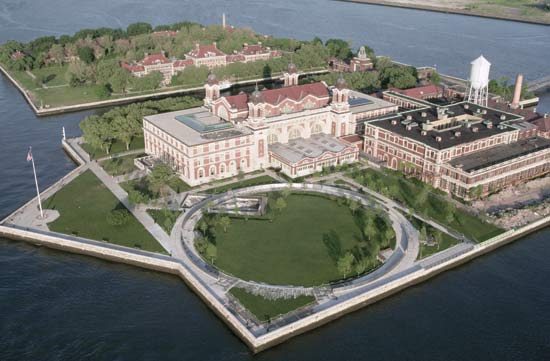
While Ellis Island is known as an immigration center, it has a rich history prior to the immigration era. In the 18th century, Ellis Island was known as Kiosk or Gull Island. The natives valued Gull Island because it was covered with rich oyster beds and the site of shad runs. As the owners of the island changed, so did the purpose of the island. In 1794 Ellis Island played a role in the military. When the British navy came to North America for the Revolutionary War, they were able to sail without challenge into New York Harbor. Because of this, the United States purchased Ellis Island from New York prior to the War of 1812 in 1808. On the island the military installed guns to prevent vessels from entering New York Harbor.
For years foreigners in search of a better life have crossed the Atlantic Ocean to America. The first place they stopped at was Ellis Island, an immigration station where Ellis Island fist opened on January 1, 1892 and operated until 1954. During the 62 years of operation, Ellis Island processed thousands of ships packed with immigrants. Upon setting foot on the island, immigrants were tagged with information from the ship and were required to pass a medical examination to determine whether or not the immigrant should be allowed to enter the United States. While the majority of the immigrants were granted access to America, about 80%, those who failed the medical examination were detained. Some were detained for long periods of time ranging from days to weeks. Those who passed entered New York or traveled to other destinations such as New Jersey.

In 1921 and 1924 the passage of the Immigrant Quota Act and National Origins Act limited the number of immigrants allowed into the country and ended the era of immigration. From 1924 to 1954 23 million immigrants were allowed into the country, which still accounted for more than half of the immigrants who arrived in America during the time period.

One reason why people wished to come to America was freedom. From when it was completed on Liberty Island in 1886 until modern day, the Statue of Liberty was a symbol of freedom. The Statue was made to celebrate the friendship between the United States and France. Frederic-Auguste Bartholdi, a French sculptor, fashioned the statue out of copper and worked with Alexandre-Gustave Eiffel, who designed the steel structure. Alexandre-Gustave Eiffel was also the same man who the Eiffel Tower in Paris is named after. The project was to be completed in 1876 to commemorate the 100-year anniversary of the Declaration of Independence. In order to complete the task on time, the French were to design and build the statue while the Americans were to build a pedestal on what was later named Liberty Island. However, due to lack of funds, the project didn't commence until 1875 and was not completed in time for the centennial anniversary of the Declaration of Independence. Bartholdi completed his masterpiece in 1885 and broke the statue down and packaged it into over 200 crates.
Meanwhile, Joseph Pulitzer used his newspaper "The World" to raise money for architect Richard Morris Hunt. Hunt built the pedestal on Bedloe's Island, the home of Fort Wood, a War of 1812 fortress. In June of 1885, the 200 crates arrived aboard the vessel Isere. In all of four months, the Statue of Liberty was put together and on October 28, 1886 President Grover Cleveland officially dedicated the Statue of Liberty.

The Statue of Liberty stands 305 feet 6 inches above the water, weighs about 450,000 pounds, and is a symbol of America and the freedom we are blessed to live with.