Sunday, June 12, 2011

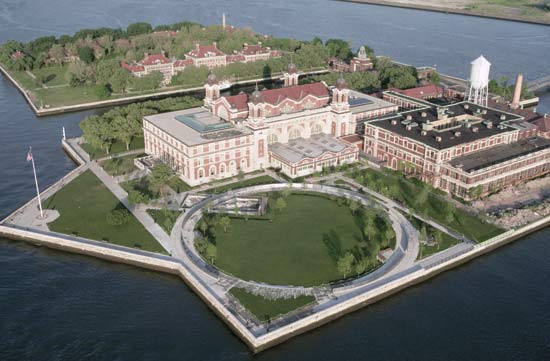
The Statue Of Liberty, A Sight For Sore Eyes From Ellis Island


While Ellis Island is known as an immigration center, it has a rich history prior to the immigration era. In the 18th century, Ellis Island was known as Kiosk or Gull Island. The natives valued Gull Island because it was covered with rich oyster beds and the site of shad runs. As the owners of the island changed, so did the purpose of the island. In 1794 Ellis Island played a role in the military. When the British navy came to North America for the Revolutionary War, they were able to sail without challenge into New York Harbor. Because of this, the United States purchased Ellis Island from New York prior to the War of 1812 in 1808. On the island the military installed guns to prevent vessels from entering New York Harbor.
For years foreigners in search of a better life have crossed the Atlantic Ocean to America. The first place they stopped at was Ellis Island, an immigration station where Ellis Island fist opened on January 1, 1892 and operated until 1954. During the 62 years of operation, Ellis Island processed thousands of ships packed with immigrants. Upon setting foot on the island, immigrants were tagged with information from the ship and were required to pass a medical examination to determine whether or not the immigrant should be allowed to enter the United States. While the majority of the immigrants were granted access to America, about 80%, those who failed the medical examination were detained. Some were detained for long periods of time ranging from days to weeks. Those who passed entered New York or traveled to other destinations such as New Jersey.

In 1921 and 1924 the passage of the Immigrant Quota Act and National Origins Act limited the number of immigrants allowed into the country and ended the era of immigration. From 1924 to 1954 23 million immigrants were allowed into the country, which still accounted for more than half of the immigrants who arrived in America during the time period.

One reason why people wished to come to America was freedom. From when it was completed on Liberty Island in 1886 until modern day, the Statue of Liberty was a symbol of freedom. The Statue was made to celebrate the friendship between the United States and France. Frederic-Auguste Bartholdi, a French sculptor, fashioned the statue out of copper and worked with Alexandre-Gustave Eiffel, who designed the steel structure. Alexandre-Gustave Eiffel was also the same man who the Eiffel Tower in Paris is named after. The project was to be completed in 1876 to commemorate the 100-year anniversary of the Declaration of Independence. In order to complete the task on time, the French were to design and build the statue while the Americans were to build a pedestal on what was later named Liberty Island. However, due to lack of funds, the project didn't commence until 1875 and was not completed in time for the centennial anniversary of the Declaration of Independence. Bartholdi completed his masterpiece in 1885 and broke the statue down and packaged it into over 200 crates.
Meanwhile, Joseph Pulitzer used his newspaper "The World" to raise money for architect Richard Morris Hunt. Hunt built the pedestal on Bedloe's Island, the home of Fort Wood, a War of 1812 fortress. In June of 1885, the 200 crates arrived aboard the vessel Isere. In all of four months, the Statue of Liberty was put together and on October 28, 1886 President Grover Cleveland officially dedicated the Statue of Liberty.

The Statue of Liberty stands 305 feet 6 inches above the water, weighs about 450,000 pounds, and is a symbol of America and the freedom we are blessed to live with.

Columbia: Roots and Shoots

Columbia University was not always known as such. In 1754, after acts passed in the New York General Assembly to allot funds, the establishment of what would become Columbia University graced Trinity Church—what is now lower Broadway in Manhattan. There, by royal charter of King George II of England, King's College was established.

Columbia began small, with one President—Samuel Johnson—who  who coincidentally served as the only instructor teaching a class of eight students. Nevertheless, the school has always been committed to higher learning, the expansion of the mind, and quality of the individual. This ideal, solid throughout Columbia's many years, remains true today, and it could be traced to its origin as well. An early manifestation of the institution's aims was the establishment of the first American medical school to grant the M.D. degree in 1767.

The American Revolution halted such institutional progression, but the figures Columbia produced managed to keep Columbia's flare lit ablaze: figures such as John Jay, the first Chief Justice of the U.S. Supreme Court, and Alexander Hamilton, the first Secretary of the Treasury.

Upon the college's resurrection in 1784, it was renamed: Columbia College. In 1857, the college moved from Park Place, near the present site of City Hall, to Forty-Ninth Street and Madison Avenue, where it remained for the next forty years. The college began to come into its modern shape around this time: the Columbia School of Law was founded in 1858; the country's first mining school and Ph.D. opportunity was offered in 1864 and 1875, respectively; Barnard College for women became affiliated with Columbia in 1889; the medical school came under the aegis of the university in 1891; followed immediately by Teacher's College in 1893. The introduction and development of graduate institutions and undergraduate programs established Columbia as one of the most prominent educators of young minds not only in the U.S. but throughout the world. As such, the college was renamed for the last time in 1896 to Columbia University.

From there, the university moved once more, this time to its contemporary home, to the more spacious Morningside Heights in Manhattan. Columbia emerged as a preeminent national center for innovation and scholarly achievement. The School of Journalism was established by Joseph Pulitzer in 1912. In 1919, a course on peace and war internationally originated both the acclaimed and controversial Core Curriculum that continues to define Columbia University today.
Columbia continued to grow, expand, and prosper, until its most turbulent time in the 1960's, soon after celebrating its bicentennial. Currents of civil unrest and challenge to authority swept U.S. citizens, especially the youth, who formed popular protests to some of the nations most immense issues, among them opposition to the Vietnam War. The protests converged at Columbia University during the last week of April in 1968; students occupied five Columbia buildings, effectively shutting down the University, until they were removed by the N.Y.P.D. These events led to the moral and financial decline of Columbia University, the retirement of President Grayson Kirk, the cancellation of campus projects, and the loss of national prominence. Notably, it also contributed to the creation of the University Senate, which continues today to provide a voice for staff, students, and alumni of the Columbia network regarding university affairs.
Columbia bounced back expeditiously, however, with the creation of new campus schools and programs like the School of the Arts, and the renovation of much of the university's campus. Columbia is a place of "doubled magic," said Columbia alumnus Herman Wouk, a place where "the best things of the moment were outside the rectangle of Columbia" and "the best things of all human history and thought were inside the rectangle." Columbia is the oldest institution of higher learning in the state of New York, and it is the fifth oldest in the country.
Clear in its historic commitment to the individual and education, led by it's new and current President, Lee. C. Bollinger, Columbia proudly celebrates its recent 250th anniversary as it looks ahead to the many achievements to come in its illuminated future.


Bard College

Because we are heading off to New York in (goodness the days are flying by) a week and a half, Mrs. Lilhanand, our chaperone, suggested to us that each student pick one topic and research it, so that when we reach the Big Apple and start our sight-seeing, we'll have, as she put it, a "resident expert" on each visit. I chose Bard College to blog about, because it’s on my short-list of colleges and seems like an interesting school at the very least. Enjoy!

Covering more than 500 acres of land, Bard sits at the edge of the Hudson River in New York, about ninety miles away from New York City and a two-hour drive away from Massachusetts.

Bard College was originally known as St. Stephen's College, founded in 1860 during the tumultuous year before the secession of the Southern states that kicked off the Civil War. Associated with the Episcopal church of New York City, the college offered a curriculum that prepared devoted men for entrance into the seminaries of the church.
In 1919, under the watchful eye of Dr. Bernard Iddings Bell, the school began a change to a more secular curriculum with a wider scope and breadth with the inclusion of social and natural sciences.


In 1928 St Stephen's College became an undergraduate school of Columbia, and in 1934 the college officially changed the name to Bard College to honor the founder, John Bard. The Dean at the time of the re-naming was one Donald Tewksbury, who was one of the first in this period of America higher education to place an emphasis on both fine and performing arts in a liberal arts curriculum. In the '40s Bard expanded its repertoire by engaging professors from Europe to teach varying subjects, from economy to symphony orchestra to philosophy. In 1944, Bard became a coeducational college in its own right, severing its ties with Columbia while maintaining an affiliation with the Episcopal church. After this, Bard attracted more professors who brought the school prestige in the arts of literature and writing. Also during this period came several of Bard's stated academic goals for its students, which still are applied today and rely largely in part on promoting an independent and self-thinking student with a common code of ethics and an understanding of the history of humans.
The modern Bard does have some differences from its expansion in the 20th century. The college is organized as, as it says on the Bard website, “a central body surrounded by significant institutes and programs - “satellites” - that strengthen its curriculum.” This unique structure makes Bard College very different from the larger universities as its focus is primarily on undergraduate studies, with each “satellite” of research, graduate study, or community outreach serving as an educational enhancement for the undergraduate students at Bard.
Richard B. Fisher Center for the Performing Arts
Music plays a large role at Bard as well. Started in the summer of 1990, the annual Bard Music Festival is designed to give the festival-goers an appreciation of the great composers. Each year, one composer is chosen as the theme, and the festival celebrates that composer by performances of their pieces, lectures, demonstrations, and essays. This musical bend eventually led to the creation Bard College's Conservatory of Music in 2005. Bard also has had a historical interest in the community, an interest that is continued today through many projects at the college: there is the Human Rights Project, an interdisciplinary program that encourages students to study and take part in the modern human rights movement; there is the Bard Prison Initiative, founded by a Bard alum, where students work to restore or promote higher education in New York prisons.

Bard College seems like a great place to visit, and I'm excited to see it, although I must admit I'm also very eager to enjoy the views on the train ride up from NYC to Bard, as I've heard the view along the Hudson is spectacular.

Monday, June 6, 2011

Great Expectations, Greater City

And so, I begin my final blog until departure.

It's more than a cumulative review of the orientation: it's a reminder that I am almost there. I'm almost finished with the preliminary portion of the Ivy League Connection. I've been through essays, interviews, tutorials, dinners, school board meetings, and hard times in general. Finishing the orientation is almost like reaching the final stage of a sort-of surreal game.

And, that's pretty cool.

The orientation actually surprised me in that there were more questions to be asked and more answers to be given. And, in realizing that, I can appreciate just how much work, time, and effort goes into this trip--not just for me, but for my cohorts and the rest of the ILC as well. Consideration is universal and across the board for this trip. From airfare, to the itinerary, to the curriculum, to subways, to dorm-room living, to weekend RA trips, to spending money, to opportunity as a whole, we are a far greater investment than I, and I would venture to say others, have honestly and earnestly realized. And, I acknowledge that now. I am gracious for such.

It really is outstanding.

Further, it was pretty inspiring to see the sea of faces in the El Cerrito High School Library. There are a lot, a rife amount, of students (and parents) participating in this program, and soon these same students will be scattered throughout the East Coast. It's not that I never appreciated such an organization and such an opportunity, it's that the scope was not in perspective for me. But, I'm catching on.
What was most exciting to hear more about was the ILC Press, to be introduced this coming Fall. It was, however, spoiled slightly for me, as I had overheard an exchange about it before. But, it was certainly exciting to expand my knowledge on the idea. And, I'm fully supportive of it. Just by reading these blogs I've seen some astounding writing--lines that make you read twice. And, I feel as though the ILC naturally attracts great writers. I mean, the very first task to attain a position in the program is the essay, which says something powerful in and of itself.

Anyway, the ILC Press will be a great addition to the ILC as a whole, and, as stated at the orientation, I do not believe there is another program, organization, or opportunity for teenagers to pursue professional writing and explore careers related to such in high school. And so, I myself, as others I hope, would jump at the chance to get involved in such a program. The possibilities are quite broad, and the potential is huge. I wish it the best, and I've already began spreading the word of such.

It's oh so exciting.

As the day of departure draws near, however, the expectations looming over our shoulders grow heavier. To that same end, however, I feel myself growing stronger, able to support that additional weight, per se. What is expected of me is great; it is immense. But, what I expect of the city is greater. And, I've only got 16 days left to prove that.


Sunday, June 5, 2011

Post-Orientation Realizations

It really wasn't until after the orientation at the library at ECHS that it truly hit me: this is really happening.
I'm going to New York in the summer.
I'm going to Columbia in the summer.
That's... amazing.

I can't say for sure what exactly did it. It wasn't hearing from former-ILCers about their experiences at Ivy League schools; it wasn't going over the itinerary with Mrs. L and my parents and the other Columbia-bound students; it wasn't talking about book requirements for the course. But, at the same time, it must have been all of those things and more. When I walked out the front doors of my school, I wasn't thinking about my upcoming physics final, or the blessed approach of lazy summer days, or what to do as a send-off for a favorite foreign exchange student heading home after graduation. My head was whirling with thoughts of New York: what I would do, who I would meet, what I would wear, what I would learn. Whirling with thoughts of Columbia and how magnificent it'll be when I arrive there. Whirling with thoughts of just how much I'd miss my family: will I call home every day, saying how much I'm homesick for everything in California, or will I dive in head first without a second glance?

I went shopping with my mother today (or rather I should say yesterday; its very early morning now), scoping out clothing for the humid east coast summer I'd be dealing with for close to a month. That was another moment that drove it home for me. Standing in a fitting room, mentally debating the merits of looser-but-less-familiar cotton shorts versus my ever-so-steadfast jean shorts that would perhaps be uncomfortably hot in the humidity, it all hit me again: this is really happening. Even two days after the orientation, I'm still getting these occasional waves of impending movement, the future washing over me when I least expect it.

But, I should stop rambling on about shopping sprees in Emeryville and talk a bit about the orientation. I wasn't as early as I'd liked to be, verging on the point of almost being late (which I'm worried is becoming my M.O. in the program, something I'm going to have to work very hard in the future to disprove). I enjoyed hearing about the ILC Press, which had been mentioned previously at the dinner in San Francisco but was detailed a bit more Thursday evening. The idea of high school students, students like me, having their poems and stories and novels published in a true publication is a stroke of brilliance, and I'm really heartened and proud to see the WCCUSD implementing visions like this, even after the success of the Ivy League Connection. I feel like the ILC Press will do a lot to help students in the district get a leg-up on whatever careers in writing they choose, and it will also encourage other students, those with less of a literary bent, to take up a pen and explore their own creativity through writing when they see their published peers enjoying the benefits of the publication.

Don talked a bit about his loaner items (emphasis on “loaner”!) and shared some advice for the technical side of our packing; although I'm tempted to borrow a security cable from him, the safety it provides seems like a decent investment even after this summer, so I think I'll purchase a permanent one for myself.

When we moved away from the main group of people into separate rooms for every school, it was really helpful to hear from someone who'd participated in the program at Columbia before. Yueming, the sister of my fellow student Eric Wang, was at the orientation to talk about her experiences in the Presidential Powers course at the university, and she was more than willing and very able to answer the questions we threw at her to try to remedy our ignorance. It was great hearing about her recollections of life in the girls' dorms, which were a suite style arrangement that Yueming described as “like living in a sorority,” which will certainly be a memorable experience! And perhaps its only because here in Kensington we have only one (relatively ill-equipped) library at our disposal, but I was really impressed to hear that the students during the summer had access to two libraries. Yueming gave us some helpful hints on what we did not need to bring (25-foot ethernet cables are not necessary at Columbia, thank goodness) and described the way her Presidential Powers course was run in a discussion-based way; I'm excited to learn whether or not my Constitutional Law course is the same.

Then we covered the itinerary. Mrs. L gave us out all our packets o' stuff, containing everything from hotel reservations to airline confirmations to our planned train rides to visit colleges. The itinerary got me thinking about what exactly I wanted to see while I was in the Big Apple: museums, Broadway shows, art galleries, what? Of course my mother's inner New Yorker came out when we started talking as a group about we just had to see: she suggested we go see the Cloisters, owned by the Metropolitan Museum of Art. I kept remembering Beilul's suggestion at our last meeting that we go see the Harry Potter 7 Part 2 movie at its midnight screening in New York; I'm hoping she's as busy concocting plans to convince an R.A. to take us as I am because, hey, two minds are better than one. But if I think about it, what I desperately want to do is watch the fireworks around the Statue of Liberty on the 4th of July, preferably from the water. I've got this old picture from when I was last in New York: can't you just see the brilliant fireworks exploding off to the right against a black sky with the city glittering in the background?

Saturday, June 4, 2011

And Off We Go!


Last night all 35 of us ILCers attended a mandatory orientation, which was our last time meeting together before our big trip. We had words from Mrs. Kronenberg and Mr. Ramsey about our programs and what will be expected of us once we leave. Don showed us all of the loaner items that he will be giving out if needed for our trip.

Not many people can say they would be excited to write a 20 page research paper, but I am. The whole experience excites me! There is hardly anyone else that can say they will be attending Columbia University in the summer and take a class by a real college professor. Not only that but we get the opportunity to have college work before they go to college. I'm ready to tackle that essay!

Eric's sister, Yueming, spoke to us about the program since she attended it last year. She informed us on how the dorms worked, weather, and everything we needed to know about the program. My favorite part was when she told us our class doesn't start until 10:00 AM meaning we have a chance to sleep in a little if we would like. Looks like being away from home will not be too bad after all...
Our chaperone, Mrs. L., told us about all of the exciting things we can do in New York while we are there. We have access to some of the greatest museums in the world, not to mention the greatest historical sites in the country. From Times Square to Ellis Island, we have it all in our reach. I'm excited to learn inside of the classroom of course, but there is also a great learning experience waiting outside of the college.

This milestone event to me is almost like having the people who support us giving us our wings to explore the experiences that are out there waiting for us. The Columbia group will be leaving June 22nd to the Big Apple. The countdown begins...

And Off We Go!